Macarons (No Stand Mixer or Silicone Mats)
Macarons (No Stand Mixer or Silicone Mats)

Ingredients
- 67 grams egg whites, at room temperature
- 67 grams granulated sugar
- 80.4 grams almond flour, sifted
- 80.4 grams powdered sugar, sifted
Instructions
- 1
Measure out 67 grams of egg whites using a kitchen scale and allow them to come to room temperature. Weigh out 67 grams of granulated sugar. Calculate the weight for almond flour and powdered sugar by multiplying the egg white weight (67 grams) by 1.2, resulting in 80.4 grams for each. Sift the 80.4 grams of almond flour and 80.4 grams of powdered sugar into a bowl. Whisk the sifted almond flour and powdered sugar together until combined.
⏱️ 10 min
- 2
If you don't have a silicone baking mat with round circles, you can freehand pipe your macarons onto parchment paper. For more accurate and uniform sizes, print out a macaron template or create your own by tracing a round object onto a separate piece of paper. Place the template on your baking tray, then cover it with a piece of parchment paper.
⏱️ 5 min
- 3
Using an electric hand mixer, begin mixing the room-temperature egg whites on a low speed. Once frothy bubbles start to appear in the egg whites, slowly begin adding the granulated sugar. You can add a spoonful of sugar every 10 seconds or so, or add half of the sugar, mix for a few minutes, and then add the remaining sugar. Gradually increase the speed of your mixer approximately every 3 minutes until you reach a medium-high speed. Continue mixing until the meringue forms stiff peaks.
⏱️ 10 min
- 4
Add half of the combined dry ingredients (almond flour and powdered sugar) to the stiff meringue. Gently fold the dry ingredients into the meringue using a spatula. Once the batter is partially incorporated, add the remaining dry ingredients. Continue folding. After all dry ingredients are incorporated, start to "deflate" the batter by pressing the spatula against the inside of the bowl. Keep folding the batter in between deflating it to ensure the process is done evenly. Continue until the batter flows off the spatula in a continuous ribbon-like stream. This indicates it is ready for piping.
⏱️ 10 min
- 5
To prepare for piping, use a Ziploc bag as a piping bag. A number 12 piping tip can be inserted into the corner of the bag, or you can simply cut the corner of the bag if a tip isn't available. Place the prepared Ziploc bag inside a cup to help fill it, then carefully pour the macaron batter into the bag. Hold the piping tip vertically over the center of each circle on your template. Squeeze the bag until enough batter has come out to reach the edges of the circle. Gently release the pressure on the bag and give the piping tip a small swirl as you lift it up to create a smooth top. Carefully remove the paper template from underneath the parchment paper.
⏱️ 10 min
- 6
Tap the bottom of the baking tray firmly against the counter to release any trapped air bubbles. Let the piped macarons rest at room temperature until a skin forms on top. This means you should be able to gently touch the top of a macaron without any batter sticking to your finger. This step can take 15 minutes or over an hour in a humid climate. Preheat your oven to 300°F. Bake the macarons for 18 to 20 minutes. Once baked, let them cool completely on the baking tray before attempting to remove them.
⏱️ 35 min•🌡️ 300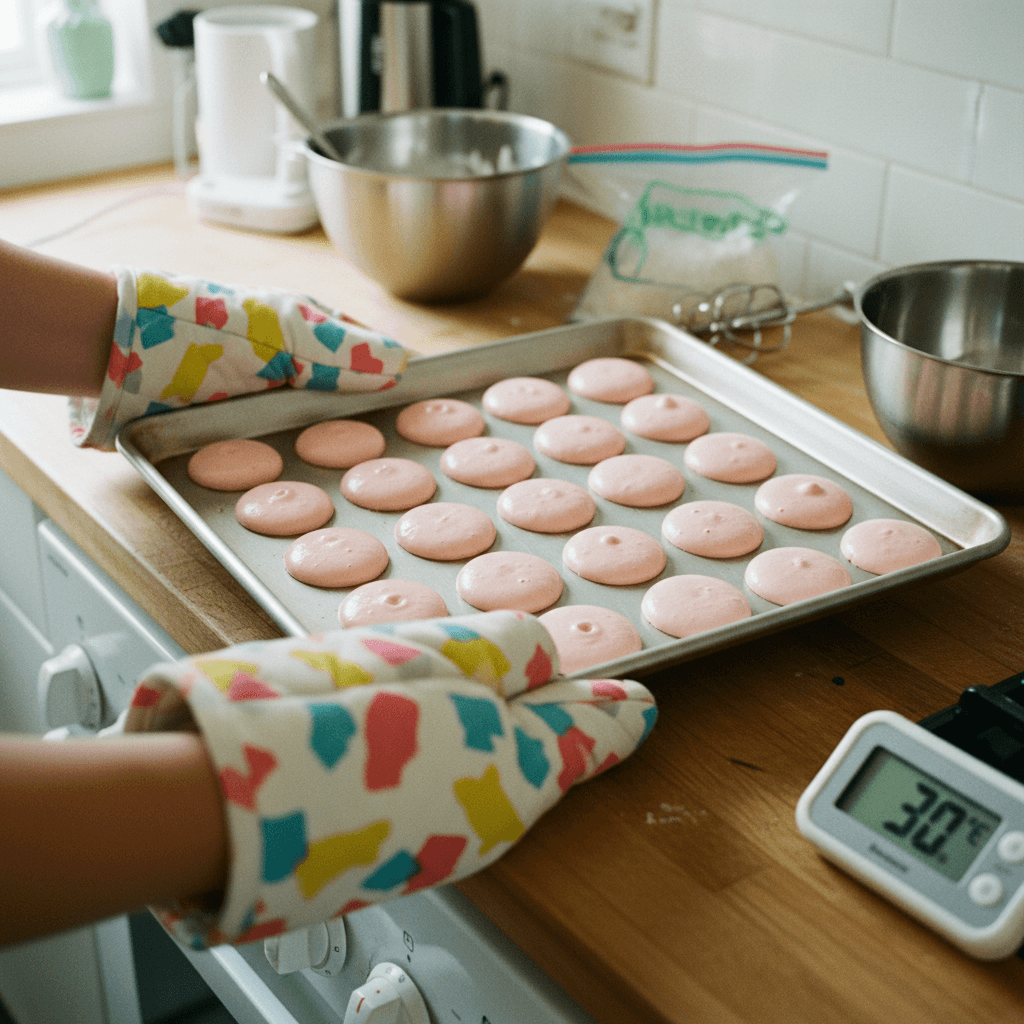
Kitchen Tools
Nutrition Facts (per serving)
Macarons (No Stand Mixer or Silicone Mats)
- 67 grams egg whites, at room temperature
- 67 grams granulated sugar
- 80.4 grams almond flour, sifted
- 80.4 grams powdered sugar, sifted
Instructions
- 1
Measure out 67 grams of egg whites using a kitchen scale and allow them to come to room temperature. Weigh out 67 grams of granulated sugar. Calculate the weight for almond flour and powdered sugar by multiplying the egg white weight (67 grams) by 1.2, resulting in 80.4 grams for each. Sift the 80.4 grams of almond flour and 80.4 grams of powdered sugar into a bowl. Whisk the sifted almond flour and powdered sugar together until combined.
⏱️ 10 min - 2
If you don't have a silicone baking mat with round circles, you can freehand pipe your macarons onto parchment paper. For more accurate and uniform sizes, print out a macaron template or create your own by tracing a round object onto a separate piece of paper. Place the template on your baking tray, then cover it with a piece of parchment paper.
⏱️ 5 min - 3
Using an electric hand mixer, begin mixing the room-temperature egg whites on a low speed. Once frothy bubbles start to appear in the egg whites, slowly begin adding the granulated sugar. You can add a spoonful of sugar every 10 seconds or so, or add half of the sugar, mix for a few minutes, and then add the remaining sugar. Gradually increase the speed of your mixer approximately every 3 minutes until you reach a medium-high speed. Continue mixing until the meringue forms stiff peaks.
⏱️ 10 min - 4
Add half of the combined dry ingredients (almond flour and powdered sugar) to the stiff meringue. Gently fold the dry ingredients into the meringue using a spatula. Once the batter is partially incorporated, add the remaining dry ingredients. Continue folding. After all dry ingredients are incorporated, start to "deflate" the batter by pressing the spatula against the inside of the bowl. Keep folding the batter in between deflating it to ensure the process is done evenly. Continue until the batter flows off the spatula in a continuous ribbon-like stream. This indicates it is ready for piping.
⏱️ 10 min - 5
To prepare for piping, use a Ziploc bag as a piping bag. A number 12 piping tip can be inserted into the corner of the bag, or you can simply cut the corner of the bag if a tip isn't available. Place the prepared Ziploc bag inside a cup to help fill it, then carefully pour the macaron batter into the bag. Hold the piping tip vertically over the center of each circle on your template. Squeeze the bag until enough batter has come out to reach the edges of the circle. Gently release the pressure on the bag and give the piping tip a small swirl as you lift it up to create a smooth top. Carefully remove the paper template from underneath the parchment paper.
⏱️ 10 min - 6
Tap the bottom of the baking tray firmly against the counter to release any trapped air bubbles. Let the piped macarons rest at room temperature until a skin forms on top. This means you should be able to gently touch the top of a macaron without any batter sticking to your finger. This step can take 15 minutes or over an hour in a humid climate. Preheat your oven to 300°F. Bake the macarons for 18 to 20 minutes. Once baked, let them cool completely on the baking tray before attempting to remove them.
⏱️ 35 min•🌡️ 300