Sweet Dough
Sweet Dough

Ingredients
- 1 kg strong flour
- 4 eggs
- 20 g sea salt
- 500 g milk, full-fat
- 80 g sugar
- 120 g butter, softened
- 30 g fresh yeast
Instructions
- 1
In a small bowl, crumble the 30 g of fresh yeast. Add a small amount (about 50 ml) of the 500 g full-fat milk. Mix with a spoon until the yeast is fully dissolved and forms a milky liquid. Set aside.
⏱️ 3 min
- 2
In a large mixing bowl, add the 1 kg of strong flour. Create a well in the center of the flour.
⏱️ 2 min
- 3
Pour the dissolved yeast and milk mixture into the well of the flour. Add the 4 eggs to the mixture.
⏱️ 1 min
- 4
Using one hand, begin mixing the ingredients from the center outwards, gradually incorporating the flour. Continue mixing until a shaggy dough forms and most of the flour is incorporated. The dough will be quite sticky at this stage.
⏱️ 5 min
- 5
Sprinkle the 20 g of sea salt and 80 g of sugar over the dough.
⏱️ 1 min
- 6
Transfer the dough to a clean, lightly floured work surface. Begin kneading using the Bertinet method: stretch the dough away from you with both hands, then fold it back over itself. Alternate this motion with lifting the dough, slapping it onto the surface, stretching it, and folding it. The dough will initially be very sticky. Continue kneading, scraping any sticky bits from the surface and folding them back into the main dough, until the dough starts to become smoother and more elastic, losing some of its stickiness (about 8-10 minutes).
⏱️ 10 min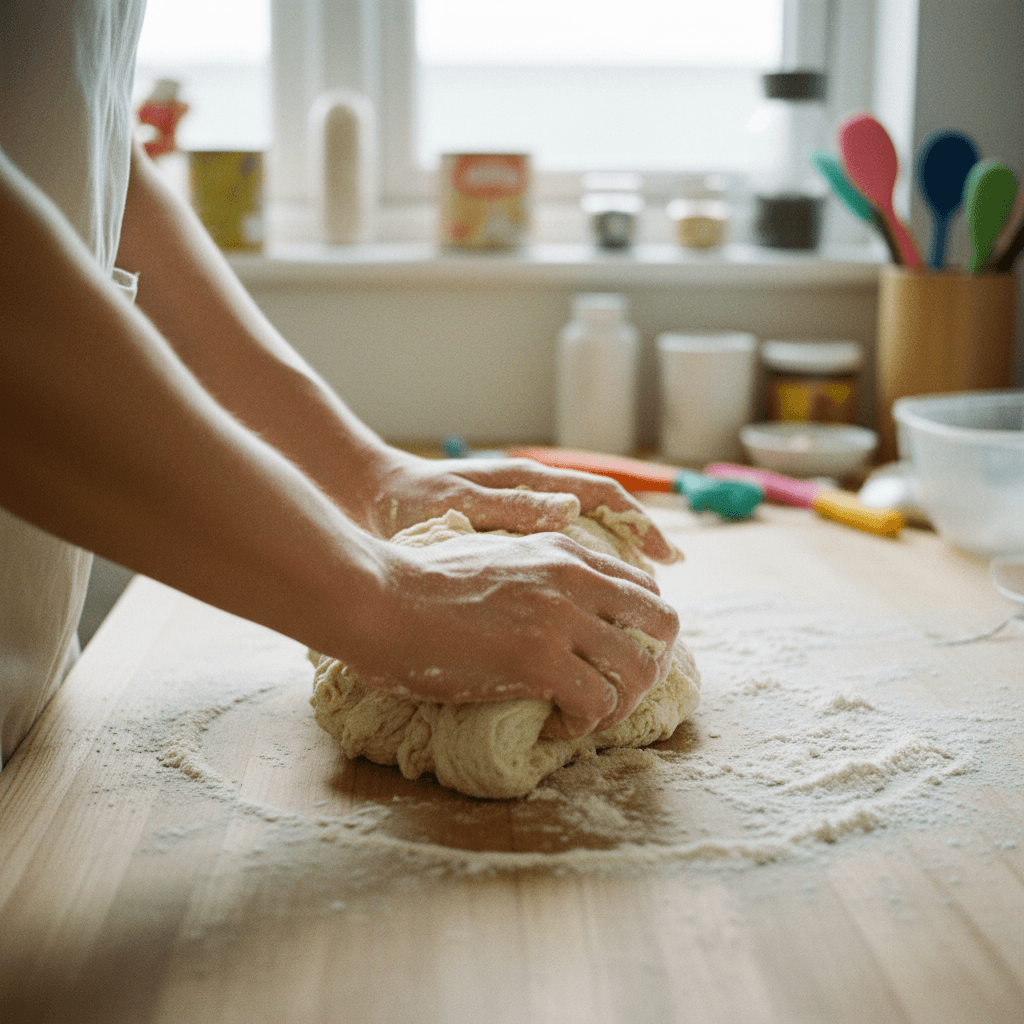
- 7
Once the dough has developed some structure, add the 120 g of softened butter in small pieces over the dough.
⏱️ 1 min
- 8
Continue the same kneading technique (stretching, folding, slapping) to fully incorporate the butter. The dough will become very soft and smooth. Knead until the butter is fully absorbed and the dough is elastic and no longer sticky (about 10-12 minutes).
⏱️ 12 min
- 9
Form the dough into a smooth ball. Place the dough back into the large mixing bowl. Cover the bowl with plastic wrap or a clean kitchen towel. Allow the dough to proof at room temperature until it has doubled in size. This typically takes 1 to 2 hours, depending on the room temperature.
⏱️ 90 min
Kitchen Tools
Sweet Dough
- 1 kg strong flour
- 4 eggs
- 20 g sea salt
- 500 g milk, full-fat
- 80 g sugar
- 120 g butter, softened
- 30 g fresh yeast
Instructions
- 1
In a small bowl, crumble the 30 g of fresh yeast. Add a small amount (about 50 ml) of the 500 g full-fat milk. Mix with a spoon until the yeast is fully dissolved and forms a milky liquid. Set aside.
⏱️ 3 min - 2
In a large mixing bowl, add the 1 kg of strong flour. Create a well in the center of the flour.
⏱️ 2 min - 3
Pour the dissolved yeast and milk mixture into the well of the flour. Add the 4 eggs to the mixture.
⏱️ 1 min - 4
Using one hand, begin mixing the ingredients from the center outwards, gradually incorporating the flour. Continue mixing until a shaggy dough forms and most of the flour is incorporated. The dough will be quite sticky at this stage.
⏱️ 5 min - 5
Sprinkle the 20 g of sea salt and 80 g of sugar over the dough.
⏱️ 1 min - 6
Transfer the dough to a clean, lightly floured work surface. Begin kneading using the Bertinet method: stretch the dough away from you with both hands, then fold it back over itself. Alternate this motion with lifting the dough, slapping it onto the surface, stretching it, and folding it. The dough will initially be very sticky. Continue kneading, scraping any sticky bits from the surface and folding them back into the main dough, until the dough starts to become smoother and more elastic, losing some of its stickiness (about 8-10 minutes).
⏱️ 10 min - 7
Once the dough has developed some structure, add the 120 g of softened butter in small pieces over the dough.
⏱️ 1 min - 8
Continue the same kneading technique (stretching, folding, slapping) to fully incorporate the butter. The dough will become very soft and smooth. Knead until the butter is fully absorbed and the dough is elastic and no longer sticky (about 10-12 minutes).
⏱️ 12 min - 9
Form the dough into a smooth ball. Place the dough back into the large mixing bowl. Cover the bowl with plastic wrap or a clean kitchen towel. Allow the dough to proof at room temperature until it has doubled in size. This typically takes 1 to 2 hours, depending on the room temperature.
⏱️ 90 min