Pork Tenderloin Wellington Roll
Pork Tenderloin Wellington Roll
Ingredients
For the Pork Tenderloin
- 1 1/2 pounds pork tenderloin, trimmed of silver skin
- 1/2 teaspoon kosher salt
- 1/4 teaspoon black pepper, freshly ground
- 1 tablespoon olive oil
- 2 tablespoons Dijon mustard
For the Filling
- 7 ounces bacon, thinly sliced
- 1 yellow onion, finely chopped
- 4 garlic cloves, minced
- 8 ounces cremini mushrooms, finely chopped
- 1 tablespoon olive oil
- 1/4 teaspoon kosher salt, or to taste
- 1/8 teaspoon black pepper, freshly ground, or to taste
For Assembly
- 2 sheets frozen puff pastry, thawed according to package directions
- 1 large egg, beaten
Instructions
- 1
Prepare the pork tenderloin: Pat the pork tenderloin dry with paper towels. Season generously with 1/2 teaspoon kosher salt and 1/4 teaspoon freshly ground black pepper.
⏱️ 2 min
- 2
Sear the pork: Heat 1 tablespoon of olive oil in a large skillet over medium-high heat. Sear the pork tenderloin on all sides until browned, about 2-3 minutes per side. This will take about 8-10 minutes total. Remove from heat and let cool completely on a wire rack.
⏱️ 15 min
- 3
Prepare the filling: In the same skillet, add 1 tablespoon of olive oil. Add the finely chopped yellow onion and cook over medium heat until softened, about 5 minutes. Add the minced garlic and finely chopped cremini mushrooms. Cook until the mushrooms have released their liquid and it has evaporated, and the mixture is dry, about 8-10 minutes. Season with 1/4 teaspoon kosher salt and 1/8 teaspoon freshly ground black pepper. Remove from heat and let cool completely.
⏱️ 15 min
- 4
Preheat oven and prepare pastry: Preheat your oven to 400°F. Line a baking sheet with parchment paper. On a lightly floured surface, unroll one sheet of thawed puff pastry. If using two smaller sheets, you may need to overlap them slightly and press the seam to form a larger rectangle, or use one sheet for the base and one for the top, depending on the size of your tenderloin.
⏱️ 5 min•🌡️ 400
- 5
Assemble the Wellington: Lay the bacon slices in a single layer over the puff pastry, covering a central portion large enough to wrap the pork. Spread the cooled onion, garlic, and mushroom filling evenly over the bacon. Once the seared pork tenderloin is cool, spread the 2 tablespoons of Dijon mustard all over its surface. Place the mustard-coated pork tenderloin on top of the filling.
⏱️ 5 min
- 6
Wrap the Wellington: Carefully bring the edges of the puff pastry over the pork tenderloin, sealing the seams tightly. Trim any excess pastry, ensuring a neat package. Place the Wellington seam-side down on the prepared baking sheet. If using a second sheet of pastry, you can use it to create decorative cut-outs to place on top.
⏱️ 5 min
- 7
Egg wash and bake: Brush the entire surface of the puff pastry with the beaten egg. Using a sharp knife, lightly score the top of the pastry in a decorative pattern (do not cut all the way through). Bake for 30-35 minutes, or until the pastry is golden brown and puffed, and an instant-read thermometer inserted into the thickest part of the pork reads 145°F.
⏱️ 35 min•🌡️ 400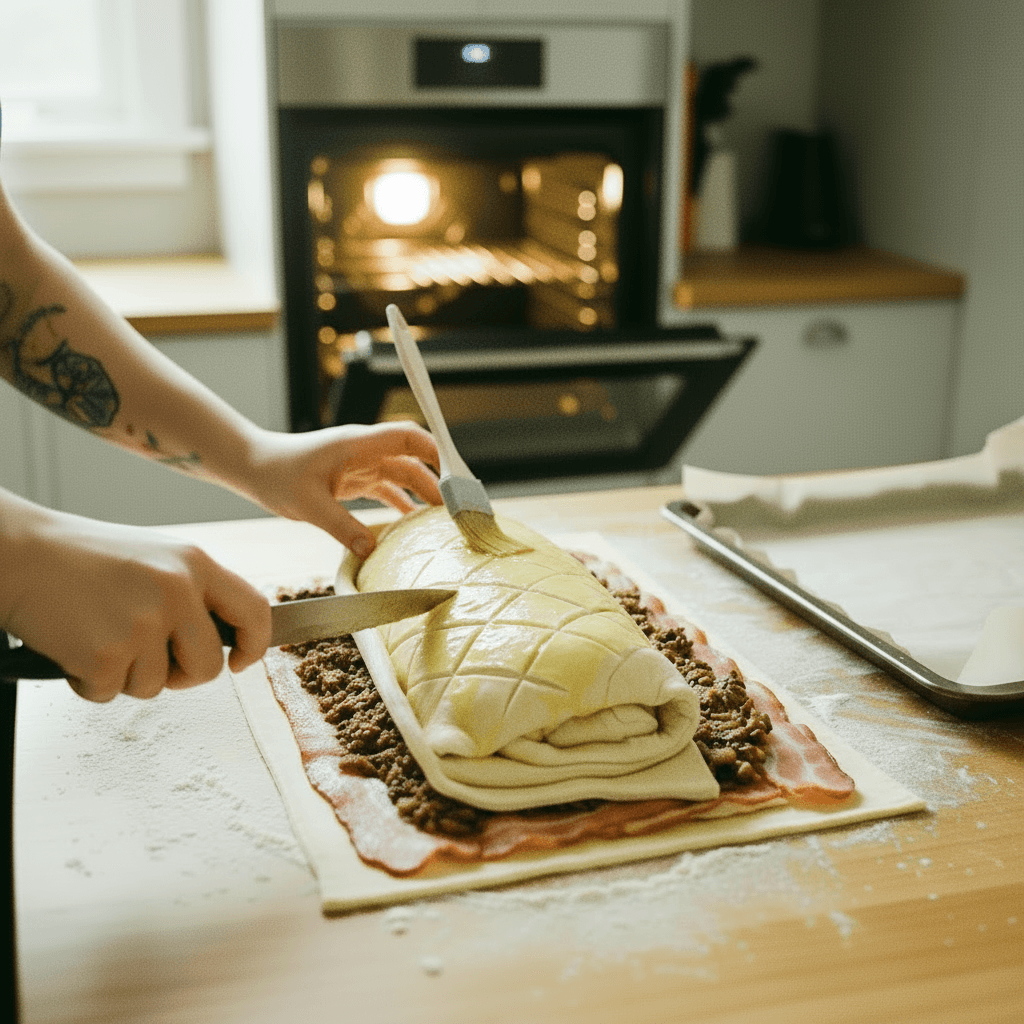
- 8
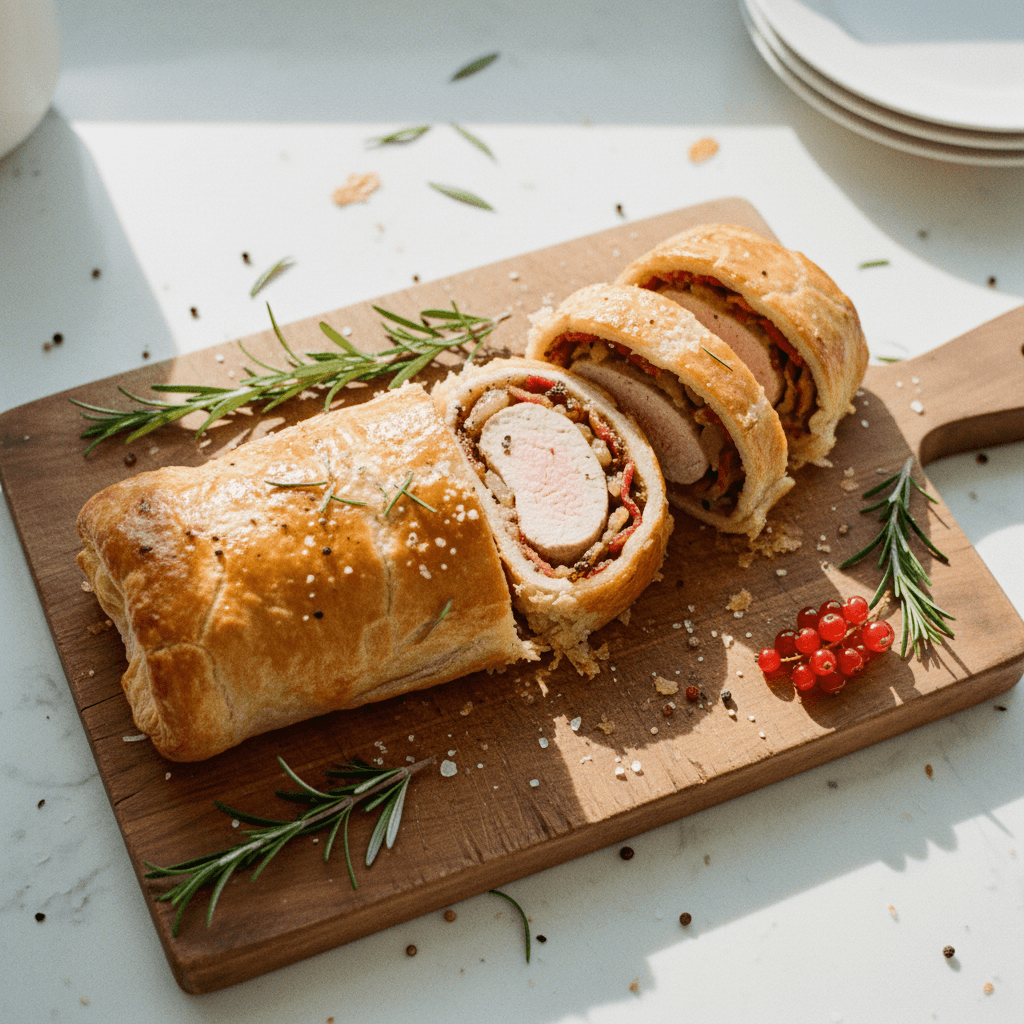
Rest and serve: Remove the Wellington from the oven and let it rest for 10 minutes before slicing into thick rounds. This allows the juices to redistribute, ensuring a tender and flavorful result. Serve immediately.
⏱️ 10 min
Kitchen Tools
Nutrition Facts (per serving)
Pork Tenderloin Wellington Roll
Ingredients
For the Pork Tenderloin
- 1 1/2 pounds pork tenderloin, trimmed of silver skin
- 1/2 teaspoon kosher salt
- 1/4 teaspoon black pepper, freshly ground
- 1 tablespoon olive oil
- 2 tablespoons Dijon mustard
For the Filling
- 7 ounces bacon, thinly sliced
- 1 yellow onion, finely chopped
- 4 garlic cloves, minced
- 8 ounces cremini mushrooms, finely chopped
- 1 tablespoon olive oil
- 1/4 teaspoon kosher salt, or to taste
- 1/8 teaspoon black pepper, freshly ground, or to taste
For Assembly
- 2 sheets frozen puff pastry, thawed according to package directions
- 1 large egg, beaten
Instructions
- 1
Prepare the pork tenderloin: Pat the pork tenderloin dry with paper towels. Season generously with 1/2 teaspoon kosher salt and 1/4 teaspoon freshly ground black pepper.
⏱️ 2 min - 2
Sear the pork: Heat 1 tablespoon of olive oil in a large skillet over medium-high heat. Sear the pork tenderloin on all sides until browned, about 2-3 minutes per side. This will take about 8-10 minutes total. Remove from heat and let cool completely on a wire rack.
⏱️ 15 min - 3
Prepare the filling: In the same skillet, add 1 tablespoon of olive oil. Add the finely chopped yellow onion and cook over medium heat until softened, about 5 minutes. Add the minced garlic and finely chopped cremini mushrooms. Cook until the mushrooms have released their liquid and it has evaporated, and the mixture is dry, about 8-10 minutes. Season with 1/4 teaspoon kosher salt and 1/8 teaspoon freshly ground black pepper. Remove from heat and let cool completely.
⏱️ 15 min - 4
Preheat oven and prepare pastry: Preheat your oven to 400°F. Line a baking sheet with parchment paper. On a lightly floured surface, unroll one sheet of thawed puff pastry. If using two smaller sheets, you may need to overlap them slightly and press the seam to form a larger rectangle, or use one sheet for the base and one for the top, depending on the size of your tenderloin.
⏱️ 5 min•🌡️ 400 - 5
Assemble the Wellington: Lay the bacon slices in a single layer over the puff pastry, covering a central portion large enough to wrap the pork. Spread the cooled onion, garlic, and mushroom filling evenly over the bacon. Once the seared pork tenderloin is cool, spread the 2 tablespoons of Dijon mustard all over its surface. Place the mustard-coated pork tenderloin on top of the filling.
⏱️ 5 min - 6
Wrap the Wellington: Carefully bring the edges of the puff pastry over the pork tenderloin, sealing the seams tightly. Trim any excess pastry, ensuring a neat package. Place the Wellington seam-side down on the prepared baking sheet. If using a second sheet of pastry, you can use it to create decorative cut-outs to place on top.
⏱️ 5 min - 7
Egg wash and bake: Brush the entire surface of the puff pastry with the beaten egg. Using a sharp knife, lightly score the top of the pastry in a decorative pattern (do not cut all the way through). Bake for 30-35 minutes, or until the pastry is golden brown and puffed, and an instant-read thermometer inserted into the thickest part of the pork reads 145°F.
⏱️ 35 min•🌡️ 400 - 8
Rest and serve: Remove the Wellington from the oven and let it rest for 10 minutes before slicing into thick rounds. This allows the juices to redistribute, ensuring a tender and flavorful result. Serve immediately.
⏱️ 10 min